
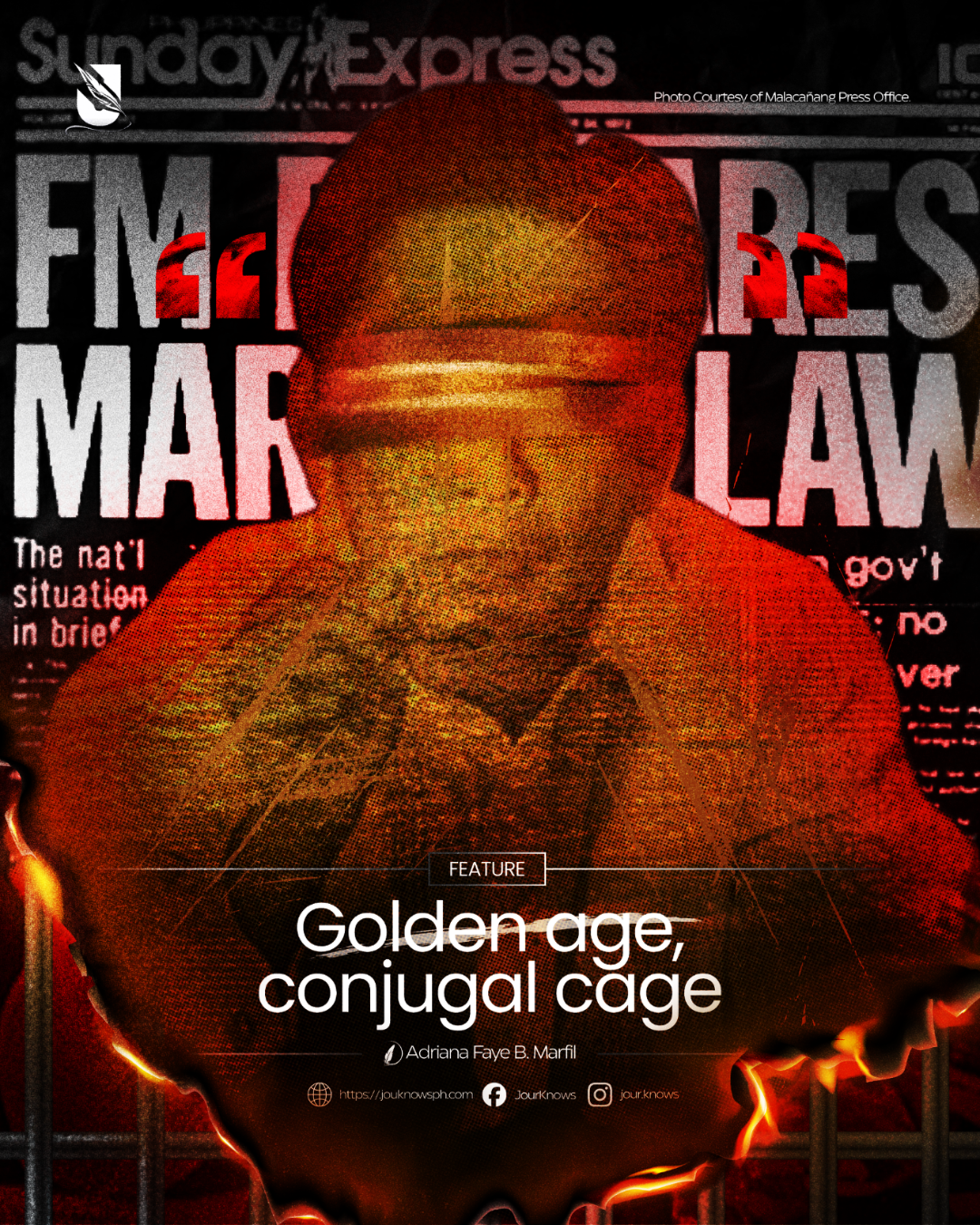
Fifty-four years ago today, former President Ferdinand E. Marcos Sr. placed the entire Philippines under martial law through Proclamation No. 1081, dated September 21, 1972 but only announced it two days later. Fourteen long years—enough for curfews to become routine, newspapers to become void, and for a presidency to become dictatorship. What followed was a marriage that ran the country like a joint account: his signature on the decrees, hers on the deeds.
Journalist Primitivo M. Mijares coined the term “conjugal dictatorship” in his 1976 exposé of the same name, written before he disappeared in 1977 and was never found. His book described a regime where power belonged to a household, split evenly between two signatures. Still, tyrants later got statues and monuments—the Marcos name collected both a mausoleum and museum-grade preservation, while the era’s casualties collected only case numbers.
Those numbers are real lives. Amnesty International’s 2018 accounting places the toll at roughly 3,200 people killed, 34,000 tortured, and 70,000 imprisoned between 1972 and 1981 alone, a period covering most of the dictatorship’s duration. The Congress passed a reparations law in 2013 that has since officially recognized and compensated 11,103 victims, a fraction of Amnesty’s broader estimate, since majority of the cases were never documented or never survived long enough to be filed.
Detention centers filled while the household’s holdings expanded. Investigators would later estimate the Marcos family’s ill-gotten wealth at between $5 billion and $10 billion, with some still unaccounted for decades on. Created specifically to recover the loot, the Presidential Commission on Good Government has clawed back around P174 billion, roughly $3.6 billion since 1986, leaving the bulk of the fortune exactly where it had been for years: gone, or well-hidden. For richer, for power, apparently, mattered more than the presidential oath ever did.
Imelda R. Marcos became a case study in her own right. Investigators uncovering the family’s wardrobe after the 1986 flight from Malacañang found, by her own 1987 account, over a thousand pairs of shoes, alongside jewelry collections that courts are still litigating today. If the shoe fits, she kept it, and kept several thousand more anyway, while roughly a third of the population lived below the poverty line during those same years.
What sets this story apart from an ordinary dictatorship, though, is its refusal to stay in the past tense. Full military honors accompanied Marcos Sr.’s 2016 burial at Libingan ng mga Bayani, the Heroes’ Cemetery, despite petitions, protests, and a Supreme Court challenge that ultimately failed to stop it. Imee R. Marcos now sits in the Senate. Marcos Jr. won the presidency by a landslide in 2022, three decades after his family’s ouster by a peaceful uprising. Evidently, a family that plunders together also runs together, and wins.
None of this happened by accident. Fact-checkers have also traced a sustained wave of revisionist content across Facebook, YouTube, and TikTok in the years leading up to that 2022 election, material rebranding the martial law years as the country’s “golden age,” heavy on nostalgia and light on casualty counts. Selling an era through infrastructure photos and orchestral soundtracks proves far easier than selling it through testimonies of torture. In sickness and in wealth, ‘til debt do the dynasty apart.
People are still relitigating history through outrage while looking squarely at what is already documented, verifiable, and largely undisputed among serious historians and international human rights bodies. Survivors, court records, and Amnesty’s own field investigators settled the question of whether abuses happened decades ago. What is left is whether a generation raised without living memory of it will bother to ask.
September 21, 2026 marks this proclamation’s 54th anniversary, not a milestone built for hashtags, which may be exactly why it seems easy to let it pass quietly. Commemoration was never meant to depend on anniversaries. It depends, instead, on whether numbers like 3,200 killed, 34,000 tortured, $10 billion missing, and a thousand pairs of shoes still mean something to people who never lived through the years that produced them.
Gilded, not solid, describes that age best: a surface applied over a household that treated a nation’s treasury the way other families treat a joint bank account. Fourteen years and fifty-four anniversaries later, the real question is not whether the past gleamed. It is who got to claim the gold, and who is still being asked to forget whose it rightfully is.